
Android 16 To Offer Triple Split-Screen Mode
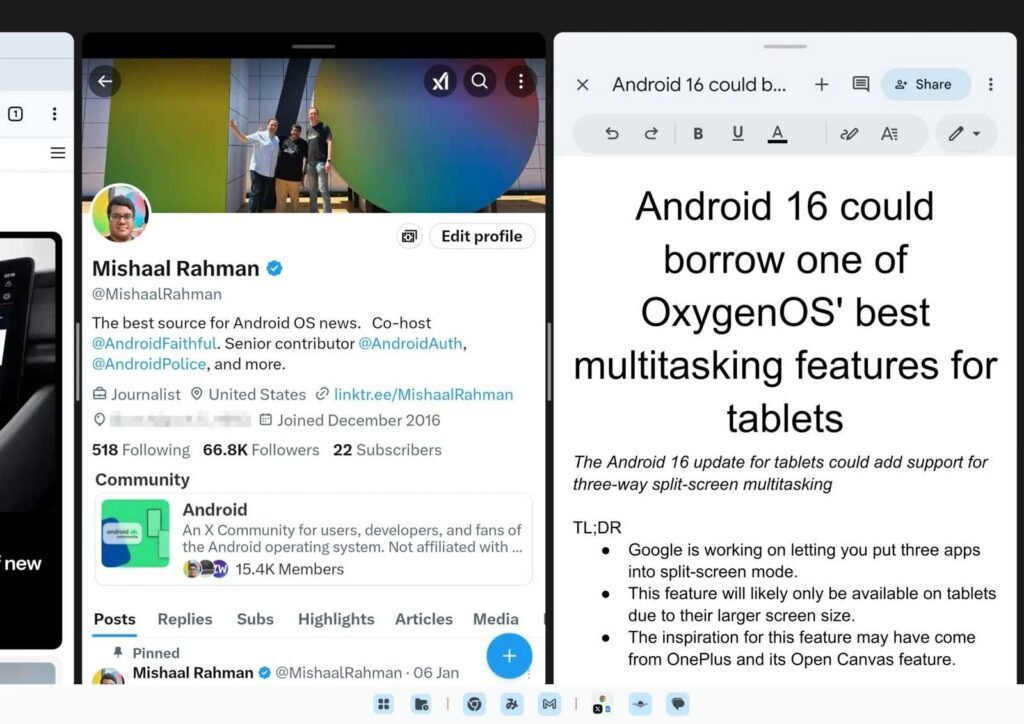
The iPad has undisputedly been the king of tablets for quite a while, but new rumors on Android 16 hint that Android tablets might just give it a run for its money, at least in terms of productivity. Some features that have been discovered on the developer preview of Android 16 are indicative of a multitasking revolution that could take the best Android tablets up a notch. Triple Split-Screen Multitasking System Google is reportedly working on a triple split-screen multitasking system for Android tablets, taking inspiration from the innovative OnePlus Open Canvas. This system, first introduced with the OnePlus Open foldable device in 2023, allows users to run three apps simultaneously. While two apps take most of the screen space, the third app sits in a smaller section to create a seamless multitasking experience. During the second developer preview of Android 16, Mishaal Rahman of Android Authority found a new setting option entitled “flexible split-screen mode.” While still a bit rudimentary, it allowed a window to be dragged into split-screen mode and then placed in one of three positions. This suggests that Google has planned for three apps side by side all along, which would go a long way toward making tablets more usable. App Pairing Boosts Productivity This new split-screen functionality is expected to work well in conjunction with the app pairs feature of Android, allowing users to save specific app layouts for rapid access. Furthermore, Android 16 wants to let users have a more natural and tablet-native multitasking experience. It also works as a simpler counterpart to the windowing system on desktops that was unveiled in Android 15, where additional setup usually is required, and it can be better carried out on desktop-like displays. Lessons from OnePlus Open Canvas OnePlus Open Canvas set a new benchmark for multitasking when it launched with the OnePlus Open foldable and later appeared on the OnePlus Pad 2 tablet. It allows three apps to remain open in a swipeable carousel. The edge of the third app is always visible, making it easy to switch between them with a simple swipe. This makes multitasking on larger screens much more practical, and Google seems to be taking a page from that book for its triple split-screen mode. The feature will probably stay exclusive to larger devices like tablets and foldables since it won’t translate well to smaller phone screens. A Leap Forward for Android Tablets If Google can pull this triple split-screen multitasking system off with Android 16, then it could mark a redefinition of the Android tablet experience. Already, current tablets like the Galaxy Tab S10 series and the Redmagic Nova gaming tablet sport impressive hardware, but better software-level productivity features might make them a fairer fight against Apple’s iPad lineup. Conclusion The potential introduction of a triple split-screen mode in Android 16 signals a major leap forward for Android tablets. By enhancing multitasking and productivity, Google could position its tablets as serious contenders in the productivity space. While dethroning the iPad remains a tall order, innovations like this bring Android tablets one step closer to achieving the impossible. Source & Image: Android Authority
Nintendo Switch 2 Officially Announced!!!
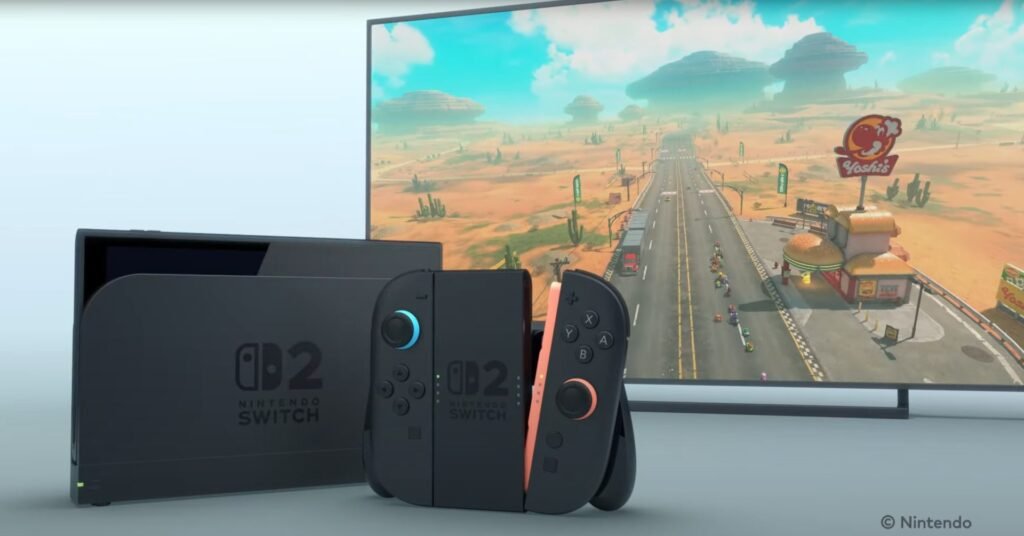
After months of speculation, Nintendo has dropped the official Switch 2 announcement with a new trailer. A whole new era for the console has begun. Here’s everything we know so far. New Features Shown in the Trailer The trailer shows some of what the Switch 2 has in store. The new console takes the original Switch and adds to it by: Bigger Screen: A bigger screen for a better gaming experience. Redesigned Joy-Con: The Joy-Con have been redesigned but not much is known about the features. Backward Compatibility: The console will support physical and digital games from the original Switch library but not all games will be compatible which may be a concern for long time fans. It also showed what looked to be a new Mario Kart game but no official confirmation or additional game info was given. Release Window and Future Announcements The trailer did confirm the Switch 2 will launch in 2025 but no specific date. The wait won’t be long though since Nintendo has announced a Nintendo Direct for the new system on April 2, 2025. Global Hands-On Events After the announcement, Nintendo will be hosting hands-on events in select cities around the world where players can try out the new handheld before it launches. Cities: 1.North America 2.New York 3.Los Angeles 4.Dallas 5.Toronto 6.Europe 7.Paris 8.London 9.Milan 10.Berlin 11.Madrid 12.Amsterdam 13.Asia and Oceania 14.Tokyo 15.Seoul 16.Hong Kong 17.Taipei 18.Melbourne Registration opens January 17, 2025 and Nintendo account is required to attend. What’s Next for the Switch 2? The Switch 2 is launching globally later this year. What do you want to hear about-specs, exclusive games, how it will improve upon the original? There is much more to come. April’s Nintendo Direct should answer many of these questions. For now, Switch 2 is looking like the hottest gaming handheld of 2025.
Samsung Is Now Offering Two New Size Options For Its Galaxy Ring

Samsung entered the smart ring market last year with the first Galaxy Ring and wowed the tech world with its sleek design and health focused features. But user feedback said more size options would be needed to reach a wider audience. Samsung listened and is expanding its offerings and big updates are coming at the Galaxy Unpacked event. New Galaxy Ring Sizes Samsung just announced two new sizes, 14 and 15, to the Galaxy Ring lineup after user feedback. These two new sizes will be available from January 22, 2025. Now the Galaxy Ring will have sizes from 5 to 15. Not only are the new sizes about inclusivity but it’s also a competitive advantage for Samsung in the wearables market. Such an expansion of the Galaxy Ring shows the company’s commitment to refine its product based on user feedback and stay ahead in the growing smart ring space. Expansion to More Markets The Ring started rolling out to more markets from July 2024. Since it launched in 38 markets including Australia, Canada, China and Turkey among others, Samsung has added 16 more regions and now the device is available in 53 markets globally. By offering both size options and expanding market availability Samsung wants to compete with the incumbents like Oura Ring which has been in the smart ring space for long. Improved Sleep and Health Features Samsung is also improving the health tracking of the Galaxy Ring. In addition to the hardware updates, the company is updating the Samsung Health app to give users more advanced sleep health features. Some of the new features: Sleep Time Guidance: Individual guidance to help users sleep better. Mindfulness Tracker: Track your mental well-being. Sleep Environment Report: Room temperature, noise levels and other factors that affect sleep. These new features shows how serious Samsung is in providing more than just basic activity tracking for health. Next Gen Prep Not much is known about the second gen Galaxy Ring but speculations are high that it will be announced at the Galaxy Unpacked event. Many are waiting to see what’s next, more battery life and other health metrics. Conclusion New sizes, more markets and more health features. Samsung is solidifying its position in the smart ring space. The Galaxy Ring is becoming a more inclusive and feature rich wearable for all types of users and heating up the wearables market. Now all eyes are on the Galaxy Unpacked event where more updates for the smart ring might be announced. Source
Nintendo Switch 2: Computing Power Revealed Through Leaks
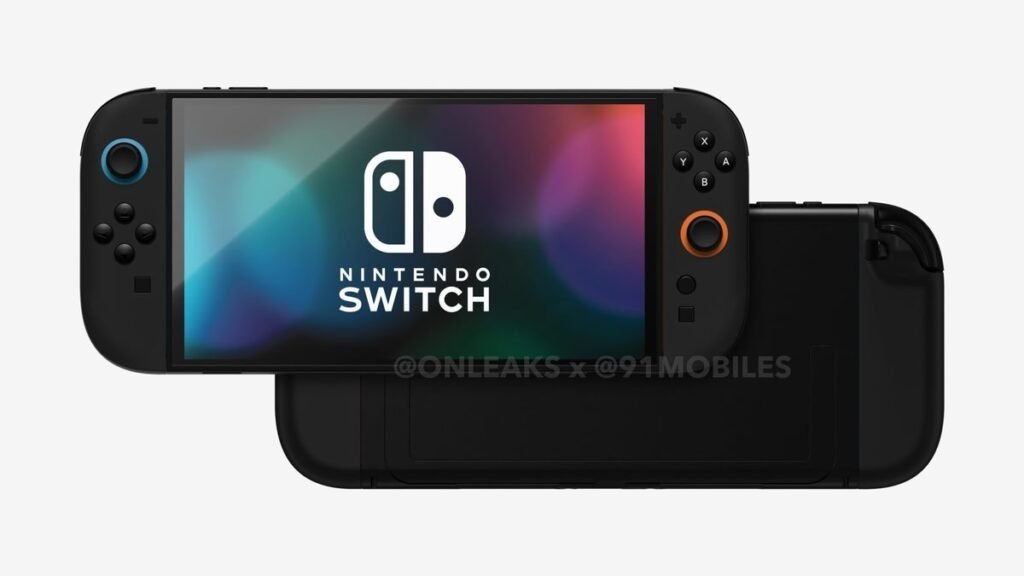
Data mining has potentially uncovered some key details about the Nintendo Switch 2’s computing power and GPU performance. It looks like the new console will have a balance of handheld convenience and docked power to stay relevant in the ever changing gaming landscape. Leaked GPU Performance According to Zachy at Famiboards, the Nintendo Switch 2 will have separate GPU clock speeds for handheld and docked modes. 561 MHz in handheld mode which is 1.71 TFLOPS. 1000 MHz in docked mode which is 3.1 TFLOPS. Its not as powerful as high end desktop GPUs like NVIDIA’s GeForce RTX 3060 at 12 TFLOPS, but this isnt even a fair comparison as the RTX 3060 is a desktop GPU. A more relevant comparison would be to the Xbox Series S at 4 TFLOPS. It’s slightly less powerful but for developers the Switch 2 performance is close enough to use Xbox Series S configurations as a baseline for porting games. Hardware Specs and Benefits The Switch 2 is said to use NVIDIA’s Tegra 239 system-on-chip (SoC) which has an 8 core CPU and a GPU based on NVIDIA’s Ampere architecture with 2048 CUDA cores. This brings some big improvements especially in modern rendering capabilities. One big plus over the Xbox Series S is the claimed implementation of NVIDIA’s DLSS (Deep Learning Super Sampling) Super Resolution and Ray Reconstruction on the Nintendo Switch 2. Ray tracing might not be used much since the GPU is not strong enough but DLSS will boost performance in games by upscaling low res graphics to higher res. This will give a more responsive gaming experience by saving system resources. Backward Compatibility and Release Date Another big plus of the Nintendo Switch 2 is its backward compatibility with the current Nintendo Switch library. This will give the new console instant access to a huge library of games so existing users can easily switch. Nintendo will release more info by the end of March 2025 which is at the end of their fiscal year. With leaks and rumors coming out daily the anticipation is building for an official announcement. 1 A Bright Future for the Nintendo Switch 2 The Nintendo Switch 2 is the bridge between portability and power. Maybe not as powerful as the Xbox Series S. But with a few features and DLSS support there’s hope for gamers around the world; so the world waits for Nintendo’s next move. Source Images: @91Mobiles
Gemini 2.0 Experimental Advanced Is Now On iOS And Android
Google’s latest Gemini 2.0 Experimental Advanced model, till now restricted to web browsers, has finally opened up on the Gemini app to Android and iOS users. The new development is crucial because it finally means that users will be able to experience this advanced AI right from mobile handsets. According to reports that came in from 9to5Google, Gemini-Exp-1206, as it is officially known, brings broadened abilities in managing complex work like advanced coding, multi-step math problems, and writing instructions with several steps. These updates would surely provide a lot of convenience and speed for professional and technical users who need great precision and efficiency. Features and Performance Gemini 2.0 Experimental Advanced was quick to set the pace and currently leads on the Chatbot Arena LLM leaderboard. It is very efficient at solving elaborate challenges, making it perfect for creating complex business plans and dealing with technical issues. However, there are some noticeable limitations: first, the model does not allow real-time access to information, and second, it is unable to upload files, which may limit its use in specific situations. Despite these disadvantages, its enhanced capabilities make it a very powerful choice for those users who need high-performance AI applications. How to Access the Model This model is currently available to subscribers of the Gemini Advanced plan using the model switcher at the top of the Gemini app. Options now available in the app include: 1.Gemini 1.5 Flash 2.Gemini 1.5 Pro 3.Gemini 2.0 Flash Experimental 4.Gemini 2.0 Experimental Advanced Worth noting is that the app defaults back to Gemini 1.5 Pro on closure, meaning users have to go back in every time to select the new model. If the updated model does not appear for Android users, one quick solution is to force stop the app and restart it. Subscription Costs and Availability Gemini 2.0 Experimental Advanced requires a premium subscription of $19.99 a month. Since the model is still in its experimental stage, Google has not said when it will roll out as the default for those subscribing to Advanced. It’s just a single-model app so far – the Gemini 2.0 Flash, and it remains unclear whether the new revision would switch to Gemini 2.0 Advanced or will go by another name. Challenges and Future Outlook As Google continues to fold this potent AI into its ecosystem, questions about competitiveness remain. The inability to access real-time data and upload files will likely make it less desirable than other AI platforms. Nevertheless, Gemini 2.0 Experimental Advanced marks a significant step ahead in AI technology and showcases Google’s commitment to pushing the boundaries of what these systems can achieve. For now, this model gives a glimpse into the future of AI and promises robust tools for professionals, with room for further refinement and innovation. Source & Images: 9to5Google
Apple Watch SE To Get A Redesign, Watch Ultra 3 Will Feature BP Monitor
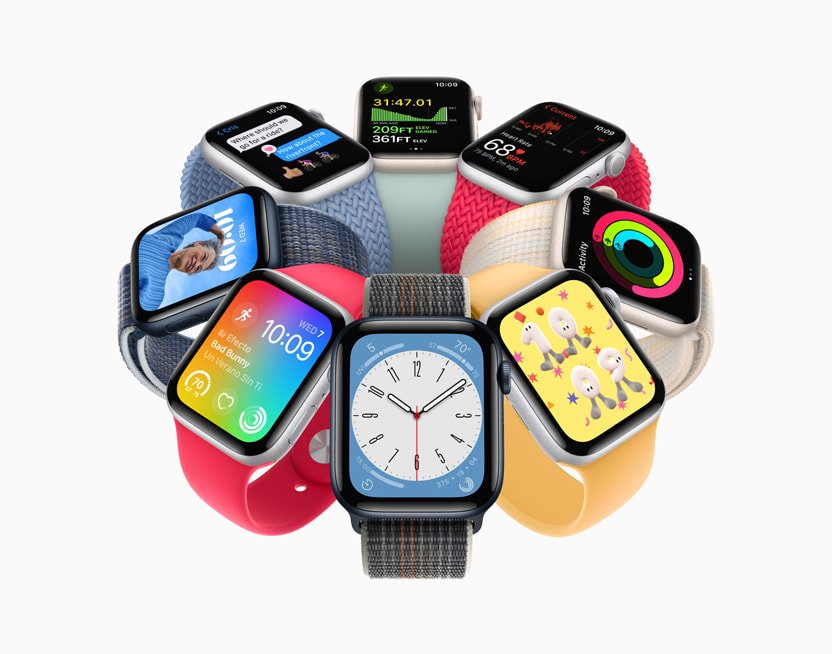
Fans of the Apple smartwatches line their calendars every September, knowing the Apple Watch sees its refresh. But the latest Power On newsletter from veteran tech journalist Mark Gurman may shine some light on exactly what that might entail for Apple’s wearable lines. Let’s take a closer look. Apple Watch SE: New Design The entry-level Apple Watch SE was last updated in 2022 and is due for a design refresh. Details remain scant, but the company will probably keep the SE 3’s design after the Series 7 to Series 9 models, following tradition. That would move the SE into modern style while still making sure it stays more budget-friendly. Apple Watch Series 11: Incremental Changes After the big design refresh that came with the Series 10, the upcoming Series 11 models will likely enjoy only minor casing revisions. Though the new cases might essentially look indistinguishable from their predecessors, word is that the Series 11 will boast many additional hardware updates, especially in performance and functionality rather than a design refresh. Apple Watch Ultra 3: Connectivity Upgrades The Apple Watch Ultra 3 is supposed to look the same as its predecessor, launched in 2022. Still, Gurman suggests some significant hardware updates, such as satellite connectivity and 5G RedCap support. The latter is a new technology that reduces 5G bandwidth for non-phone devices, which could mean better connectivity for outdoor adventurers and fitness enthusiasts. Groundbreaking Health Features Blood pressure monitoring has been the most yearned-for feature across the lineup. First said to be coming with Series 10, this had been delayed due to some reliability problems during test courses. Apple seems ready to launch this revolutionary health feature in 2025, probably setting a new record when it comes to wearable health technology. Additionally, it’s said to be working on bringing AI workouts to the smartwatch platform, which would line up with plans to push deeper into health and fitness features in the medium term and make the Apple Watch a far more complete wellness device. Wareable’s Take This adds credibility to the claims, considering Mark Gurman’s track record in predicting Apple’s plans. The refresh of the design of the SE model makes sense since it has an outdated look. But for the Series 11 and Ultra 3, their rumored upgrades might be a bit underwhelming for some enthusiasts, especially considering the unchanged looks of both models. The Ultra series, which started in 2022, has missed a major refresh since its launch. Many were expecting a big refresh in 2025, but the rumored upgrades seem more incremental and closer to what one would expect from a normal yearly refresh cycle. What’s Next? Of course, these details paint a small picture of what Apple will offer, but much is left to question. As has often been the case with updates, features and designs can change in the upcoming months. Fans of Apple will have to wait until September for an official unveiling. Keep watching for the latest on the Apple Watch as more rumors and details emerge over the coming months. Source
iPhone 17 Air Will Be Thinner Than Previously Anticipated

A Thin Replacement for the Underperforming iPhone 16 Plus Apple is reportedly working on an iPhone 17 Air, an ultra-thin version that will replace the underperforming iPhone 16 Plus. It is not a lonely move from the company, as it once attempted refreshing its lineup by replacing the ill-received iPhone Mini with the Plus variant. The iPhone 17 Air will be Apple’s thinnest phone yet, even beating the 6.9mm thickness of the iPhone 6. More recent rumors-including those from prolific analyst Ming-Chi Kuo-indicate that it could go as low as 5.5mm at its thinnest point, pushing the boundaries of phone design to a whole new level. Challenges of Ultra-Thin Design That’s no small achievement, and rumor has it Apple has been dealing with some design issues to make this extreme thinness possible. Kuo says that this minimal thickness can be so less that it could allow the utilization of eSIM technology only since there would not be enough room for a physical SIM card slot. While this technology is more common in the U.S., that is not necessarily the case globally, which may raise more issues for Apple internationally. But the “thinnest part” terminology used in the leaks suggests this 5.5mm thickness may not apply to the entire device, which probably means the phone will sport a camera bump, a common design element in modern smartphones. For context, the iPhone 16 measures 7.8mm at its thinnest point, but the camera bump brings the overall thickness to 11.28mm. If the iPhone 17 Air follows a similar pattern, that camera protrusion could make the device a fair bit thicker even if the base design remains ultra-slim. Rumored Features and Sacrifices To achieve this slim profile, the iPhone 17 Air will reportedly use only a single rear camera lens, compared to the dual- and triple-lens arrangements that have dominated most recent iPhones. That’s cause for some concern, but Apple has managed to deliver great 2x zoom on non-Pro models using advanced pixel-binning technology in the past. But the sacrifices may not stop at the camera. Kuo thinks the iPhone 17 Air will have “downgraded components paired with a high price.” That’s a mix that could make the device less attractive to consumers, especially if performance or features are noticeably sacrificed. Price and Availability This ends those very early rumors that had the iPhone 17 Air as Apple’s most expensive handset. Instead, it appears the device will slot in for the $899 iPhone 16 Plus within Apple’s lineup. Of course, that still leaves open the possibility of a general price hike across all iPhone models in 2025. The iPhone 17 Air is rumored to be announced in the latter half of 2025, which perfectly fits into Apple’s usual September releases. If all goes well, it could bring a whole new perspective to ultra-thin smartphone design, but it has yet to be seen if its compromises balance out its innovative form factor. Conclusion The iPhone 17 Air is perhaps Apple’s boldest attempt at making an ultra-slim smartphone. Although its innovative design may garner some attention, challenges like reduced features and the limited adoption of eSIMs will likely dampen its success. As the tech world awaits further details, one thing is for sure: the iPhone 17 Air could be the beginning of a whole new era in how Apple approaches the design of its smartphones. Source
Intel Shows Off Next-Gen Modular Gaming Handheld
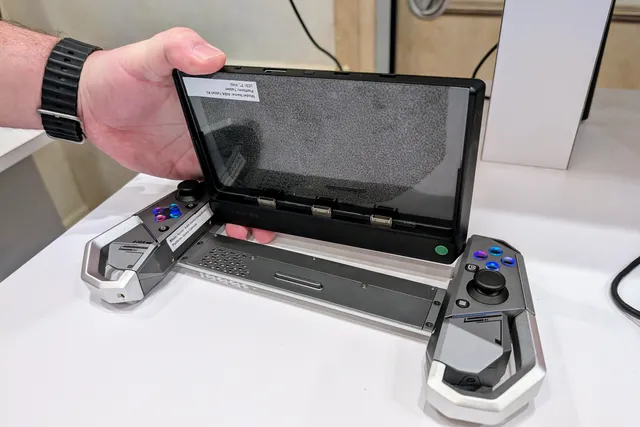
Modular has been a tech enthusiast’s dream for years because it promises to make upgrading and fixing things easier. The concept has never really taken off in practice. Maybe things will change as Intel takes the stage with its modular products at the “Innovation Showcase”. According to The Verge, Intel’s latest effort has a swappable component gaming handheld that has rekindled interest in modular tech. Intel’s Gaming Handheld: A Closer Look Details are scarce but from the leaked images sent to The Verge it looks like a sleek metallic handheld with a 7 inch Full HD display. The screen is swappable and attached via 3 separate connectors. This kind of modularity means customization options like different specifications of screens but that’s just speculation for now. The design looks futuristic and user friendly and promises flexibility for gamers who want a custom experience. Unlike previous modular devices like the AYANEO 3 which only allowed users to swap controller designs, Intel’s concept means a more comprehensive approach to modularity and potentially redefining how gaming handhelds are designed. Expanding Modular Innovation: Beyond Handhelds But Intel’s interest in modularity doesn’t stop at gaming handhelds. At the same showcase they demoed a “Lunar Lake” modular laptop, a product of its previously introduced “Compute Card” idea. This laptop has a motorized hinge that opens and closes the lid on its own, eye-tracking and a rather unusual “ring-based” mouse. It also has a Qi wireless charging pad in the palm rest-a feature that’s new and aimed at convenience. These modular devices developed with Quanta-a leading Taiwanese hardware manufacturer-show Intel’s willingness to innovate. Quanta has years of experience in AI and advanced hardware development so these designs are instantly credible. The AI8A Branding The “AI8A” branding was on the modular products at the event but what that means is anyone’s guess. Is this a new product line or a concept? Nobody knows. Whatever it is it shows Intel’s intention to lead in modular tech. The Road Ahead for Modular Devices While these are just prototypes, Intel hasn’t confirmed if these will hit consumer markets but the excitement around them shows there’s a growing appetite for innovation in the tech industry. Modular tech is one of the most promising ways for customization and sustainability especially in gaming handhelds where personalization and performance is at the core of the device. Conclusion Intel’s foray into modular tech especially with its gaming handheld is a big step forward in consumer electronics. These are still in development but the potential to disrupt the market is huge. For gamers and tech enthusiasts who have to wait a bit longer for more info, Intel’s showcase is a reminder that the best kind of innovation is the kind that pushes the boundaries. The future of modular gaming handhelds has never looked brighter. Source & Images: The Verge
Google CEO Teases New Gemini AI Features For 2025

Good Omen to Start the Year Google’s chief executive, Sundar Pichai, kicked off 2025 with an optimistic New Year’s note to staff, reflecting on the company’s progress with AI. Reflecting on the phenomenal end to 2024, he credited that success to groundbreaking projects like Gemini 2.0, Willow, and Veo 2. In his message, Pichai underlined that Google is determined to stay ahead of the AI curve, and this year is going to be no exception. AI Milestones and Upcoming Features Pichai underscored Google’s growing leadership in AI technology by mentioning several new features coming to shape the user experience in 2025. Let’s look at some of these in detail: Daily Listen Currently available on Test in Search Labs, Daily Listen is a personalized podcast feature. As such, it aims to curate a playlist of content based on the user’s liking. By deeply understanding how users behave, this tool will promise to tell users stories that fit their taste for a more engaged listening experience. Gemini 2.0 Flash In January, the company is releasing Gemini 2.0 Flash, an update to its platform for developers. The update brings many features to consumers with the improved Gemini app and a set of new, experimental capabilities accessible only by paying subscribers. NotebookLM Plus Another release to watch out for is NotebookLM Plus, which will be rolled out to Google One subscribers sometime in early 2025. This tool allows users to have AI hosts interact directly with them using voice overviews for a new kind of collaboration across individuals, teams, and organizations. First previewed last December, the feature is part of Google’s effort to introduce AI into professional workflows. Greater Integration of Gemini He also reiterated that Gemini 2.0 will integrate more deeply into core Google products such as Search and YouTube, among others. Such a development would make features such as YouTube recommendations even more relevant to its users, thereby changing the ways of discovery altogether. Supporting Wildfire Relief Not to diminish any of the new innovation excitement, Pichai first acknowledged the challenges brought by the southern California wildfires that have affected thousands of Googlers. Google opened an employee matching program in support of relief efforts and promised more funding through its philanthropic arm, Google.org. The company has also activated SOS alerts and real-time road closure updates on Maps and Waze to help the communities affected. Grateful and Looking Ahead Pichai concluded his message by thanking employees for making 2024 an extraordinary year for Google. While there were no updates on the highly anticipated Pixel 10, the focus on Gemini and AI improvements is a good omen for the company in 2025. With projects like Gemini 2.0, among others, in place, Google continues to set the stage for when AI will be even more integrated into daily life. Source
New iPad Air Models To Launch This Year With M4

Apple will put the M4 chip in its iPad Air lineup so the series above the base model will get an upgrade. Until now the M4 chip was in the top of the line 11- and 13-inch iPad Pros so the Air will get big performance and efficiency boosts without a price increase. iPad Air Upgrade to Get M4 Chip According to Mark Gurman at Bloomberg the new iPad Air will keep the current 11- and 13-inch designs but swap out the M2 chip for an M4. The Air lineup currently starts at $549 for the 11-inch with 128GB and $699 for the 13-inch so the M4 models may keep the same pricing. This will be competitive pricing and a great value proposition for the M4 chip. Why M4 Matters M4 is a huge leap forward for Apple’s silicon. The chip is fabbed on TSMC’s 2nd gen 3nm process and is up to 45% faster in some benchmarks (Geekbench 6) than the M2. M4 is faster and more power efficient than M3 Pro and Qualcomm’s Snapdragon X Elite. M4 supports ARM’s Scalable Matrix Extension which makes complex tasks easier. Good for productivity and gaming; older AAA titles like Death Stranding run smooth on this chip. Features and Limitations M4 will give the Air more performance but the tablet won’t have premium features like OLED and ProMotion which are exclusive to the pro models. These omissions will keep the iPad Air cheaper and more consumer friendly. Apple skipped the M3 chip for the Air and that’s a good sign as the M3 was a transition chip. By going to the M4 Apple is positioning the iPad Air as a powerful and efficient device in its segment. Market Impact As long as Apple keeps the Air at $599 for the M4 models this new lineup will cut through the noise. Big performance and energy efficiency at a very competitive price makes the iPad Air a great option for those who want high performance without the premium of the iPad Pro. Design and display stays the same but with M4 power the iPad Air will remain one of the best values in its segment. That’s just another proof that Apple is bringing the latest tech to all products that reach the most people. Via